
MONASH MOTORSPORT BLOG
Hear from our team of engineers, learn more about our cars and find out about our approach to the world of FSAE.
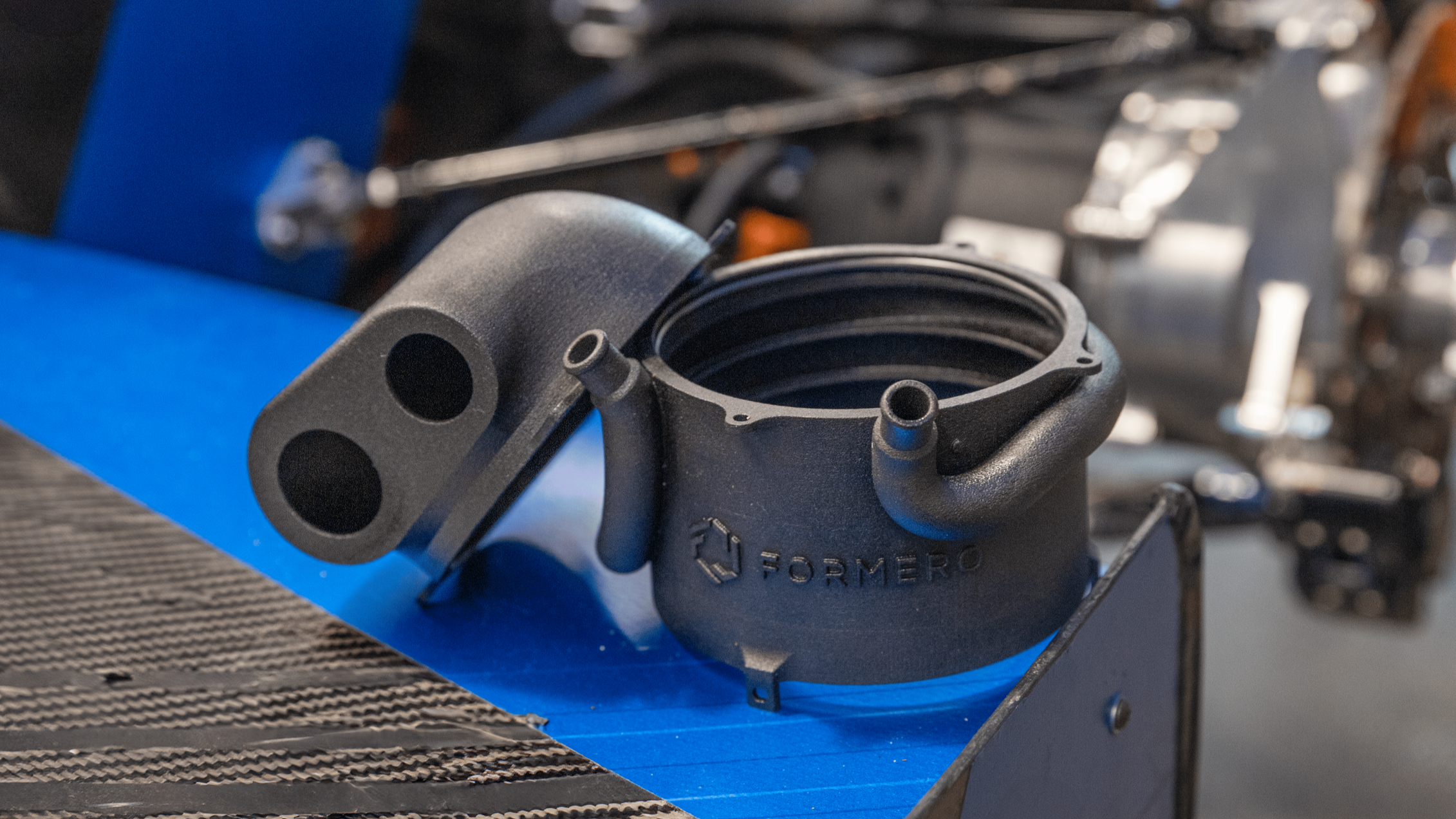
Formero: Protective, Proven and Precise Motor Shroud Printing
Formero continues to provide Monash Motorsport with world class 3D printing services for M25’s custom cooling jackets and motor shrouds. Together they protect critical wiring, provide cooling to the motors and ensure that our new custom cobalt motors can deliver reliable power, all while fulfilling this year's mass focused design requirement.

How T.I. Performance Helps Monash Motorsport Push Innovation
Monash Motorsport is proud to be supported by T.I. Performance, whose expertise and products help us push the limits of performance, reliability, and data precision. T.I. Performance is well known for their wide range of automotive sensors and performance parts. Their generous contribution to our design is in the form of linear potentiometers, a type of sensor which varies its output based on movement in one direction.

Precision in Every Layer: Formero’s 3D-Printed Monocoque Plugs
The monocoque is the backbone of our Formula SAE car - a full carbon chassis that provides the strength, stiffness, and safety essential for high performance. In order to manufacture such a complex structure, accuracy is everything. Every hatch, cut-out, and mounting feature must hold its shape throughout the curing process, where extreme pressure and temperature can easily cause distortion. To achieve this, Monash Motorsport relies on highly specialised tooling known as monocoque plugs.

Revolutionising Motor Performance: How Formero’s 3D Printed Motor Shrouds Power Monash Motorsport’s Success
Formero has been a proud sponsor of Monash Motorsport, providing us with world class 3D printing services for almost a decade. Formero prints M24’s custom motor shrouds, which protect critical wiring ensuring reliable functioning of the motors. Reliable motor power delivery and feedback ensure that M24’s motors are running as intended, so it is important to avoid these processes being interrupted.
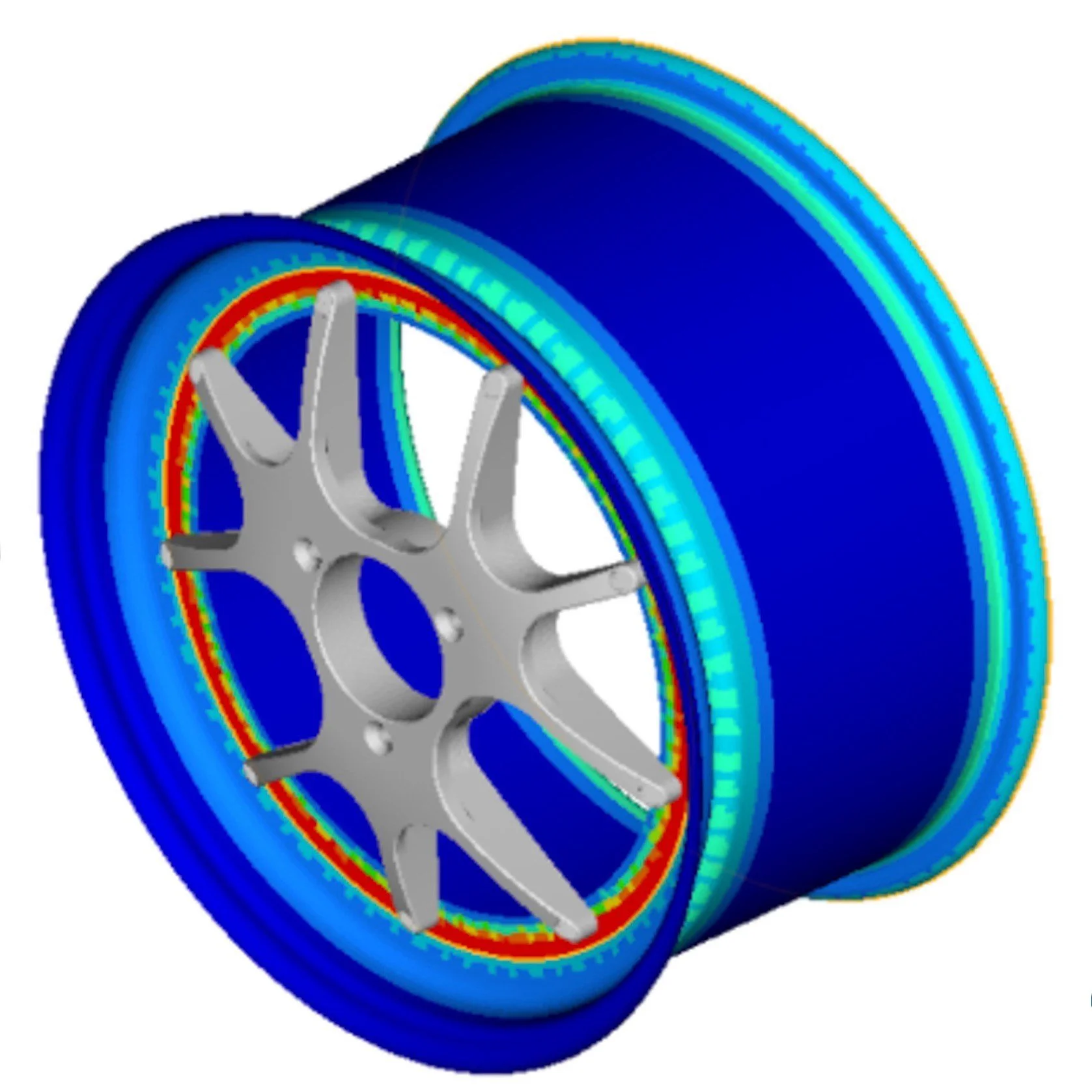
Simulated Success: Finite Element Methods by Altair
Before manufacturing any structural component of our car, rigorous analytical calculations must be conducted to justify the engineering choices made. However, the equations and theoretical models governing these calculations are inherently simplified and fall dramatically short of capturing the true complexities of real life. This is where the Altair’s Finite Element Method softwares and tools prove invaluable.

Small Yet Critical: 3D Printed End Caps by Formero
Formero has been a partner of Monash Motorsport for many years, and are renowned for their high quality 3D Printing services. Our aerodynamic wing profiles require end caps for assembly of the carbon fiber skins and to transfer loading to the mounting structure. They have to be lightweight, yet stiff enough to pass deflection rules. As such, end caps are highly important components of our car that enable our aerodynamic package to be suitably attached to the vehicle.

Printed Precision: Formero's Contribution to Monash Motorsport Cooling System
The overheating of our vehicle’s motors and inverters can cause permanent damage to the critical components within our powertrain. To effectively cool M23’s Fischer motors, we use custom cooling jackets designed by our engineers. Motor power delivery and feedback are also critical to the reliable functionality of our motors, and to ensure these aren’t interrupted, we utilise custom motor shrouds to strain-relieve these critical connections between components in the powertrain.

Designing a Receding Horizon Planner for an Autonomous Formula Student Racecar - Kerry He, 2021
In autonomous driving, the motion planning subsystem is required to determine a feasible state and control trajectory to navigate the vehicle to perform a specific task. Kerry He’s thesis presents an implementation of a receding horizon planner (RHP) to perform motion planning for Monash Motorsport’s autonomous racecar to compete in the Formula Student Driverless competition.

Path Planning and Control in an Autonomous Formula Student Vehicle - Adam Slomoi 2018
The design of a path planning and control algorithm for a formula student vehicle is one of the key milestones to competing in driverless competitions. Adam Slomoi’s Final Year Project takes us back to the team’s beginnings for autonomous driving, from optimal race line computation to control.

Baraja Spectrum-Scan™ LiDAR Comparison
Let’s dive into some comparisons between the Baraja Spectrum-Scan™ LiDAR and our previous LiDAR solution with an emphasis on real-life on-track data and differences in approaches in our perception pipeline.

The Foundation of M21's Aerodynamic Package - C5 Systems & Austuf
Delivering on the challenge of manufacturing our most complex aerodynamic package yet would not have been possible without the help of C5 Systems and Austuf . The article highlights this partnership through which we can challenge ourselves to actualize complex aerodynamic packages such as M21’s.

Ready, Set, Render - How Design Launch Night 2021 was Built in Keyshot
In early 2021, as we continued to work from home, we depended more heavily upon digital platforms to develop both the team and our 2021 driverless-electric challenger. So our team saw a unique opportunity to deepen our knowledge of the tools at our disposal and put our rendering tool of choice, Keyshot, to the ultimate test.

Baraja and Monash Motorsport: Low Voltage Integration and Software-Definable Scan Patterns
Next up on our blog series, we take a look at how Baraja has helped us with simplifying our autonomous systems pipeline through software and hardware integration. Tune in as Chris and Rashmidha take us through how low voltage integration and software-definable scan patterns that can be implemented seamlessly with Baraja’s continual support.

VEHICLE SIMULATION FOR CONCEPT LEVEL DESIGN AND SPECIFICATION OF A FORMULA SAE RACECAR - Cameron Warne 2016
In 2016 Cameron Warne based his final year project on integrating existing models into an easy to use simulator that allows both current and future team members to make informed decisions and increase the cars performance. Read about the genesis of our computer modelling system in Cameron’s Final Year Project.

Baraja and Monash Motorsport: Integration of the Spectrum-Scan™ LiDAR
Tune in for the latest edition of our blog series where Head of Autonomous Systems, Jordan Esh, takes a deeper dive into the simulations and analysis that reinforced Baraja Spectrum-Scan™ as the right LiDAR choice for the team.

Baraja and Monash Motorsport: An Introduction to the Baraja Spectrum-Scan™ LiDAR
Tune in to the first edition of our brand new blog series, Baraja and Monash Motorsport, where Head of Autonomous Systems, Jordan Esh, highlights the key reasons that motivated our exciting new partnership.

Development of the Aerodynamic Design Tools & Processes for Formula-SAE - Ryan Ockerby 2015
Ryan Ockerby’s Final Year Thesis helped us to design our aerodynamics package with greater confidence and allowed for a greater number of designs and investigations. His project aimed at improving our aerodynamic package design process by using faster solving CFD simulations running in conjunction with highly complex cornering CFD simulations, quality wind tunnel modelling and data acquisition to improve on-track testing.

Perception Integration for an Autonomous Vehicle
In 2019, our electric vehicle, M18-E, was retrofitted with sensors, computing units and actuators to become the first ever Driverless car we have produced, M19-D. Georgia Ovenden’s 2019 final year project contributes to the perception systems for our driverless FSAE vehicle.

Design and Development of Carbon Fibre Wheel Shells and Wishbones for a Formula Student Racecar - Daniel Crowe 2019
This Final Year Thesis by Daniel Crowe sets out to design carbon fibre wheel shells and wishbones for the 2019 Monash Motorsport racecars. His work utilised composite materials, instead of Aluminium or Steel to ensure a lighter, stiffer and more reliable design of the wheel shells and wishbones.

Development and Design of a Formula Exhaust System - Reece Day, 2020
This project includes a broad range of work and investigations into improving the understanding of and techniques involved in designing and fabricating a high-performance Formula SAE/Formula Student exhaust system.